- English
- French
- German
- Portuguese
- Spanish
- Russian
- Japanese
- Korean
- Arabic
- Greek
- German
- Turkish
- Italian
- Danish
- Romanian
- Indonesian
- Czech
- Afrikaans
- Swedish
- Polish
- Basque
- Catalan
- Esperanto
- Hindi
- Lao
- Albanian
- Amharic
- Armenian
- Azerbaijani
- Belarusian
- Bengali
- Bosnian
- Bulgarian
- Cebuano
- Chichewa
- Corsican
- Croatian
- Dutch
- Estonian
- Filipino
- Finnish
- Frisian
- Galician
- Georgian
- Gujarati
- Haitian
- Hausa
- Hawaiian
- Hebrew
- Hmong
- Hungarian
- Icelandic
- Igbo
- Javanese
- Kannada
- Kazakh
- Khmer
- Kurdish
- Kyrgyz
- Latin
- Latvian
- Lithuanian
- Luxembou..
- Macedonian
- Malagasy
- Malay
- Malayalam
- Maltese
- Maori
- Marathi
- Mongolian
- Burmese
- Nepali
- Norwegian
- Pashto
- Persian
- Punjabi
- Serbian
- Sesotho
- Sinhala
- Slovak
- Slovenian
- Somali
- Samoan
- Scots Gaelic
- Shona
- Sindhi
- Sundanese
- Swahili
- Tajik
- Tamil
- Telugu
- Thai
- Ukrainian
- Urdu
- Uzbek
- Vietnamese
- Welsh
- Xhosa
- Yiddish
- Yoruba
- Zulu
G610 Recycler Uses in High-Volume Cash Processing
The G610 Recycler stands as a precision-engineered cash handling module designed for high-volume environments such as banks, retail centers, and financial institutions. Originating from Japan, this recycling module handles simultaneous deposit and withdrawal operations by validating, storing, and dispensing banknotes within a closed-loop system.
It reduces Cash-in-Transit (CIT) expenses substantially by reusing deposited bills for subsequent withdrawals, cutting replenishment frequency while eliminating human counting errors. Deployed extensively in intelligent teller machines (ITMs), cash recycling machines (CRMs), and self-service kiosks, the recycler integrates seamlessly into existing infrastructure while enhancing operational throughput and accuracy.
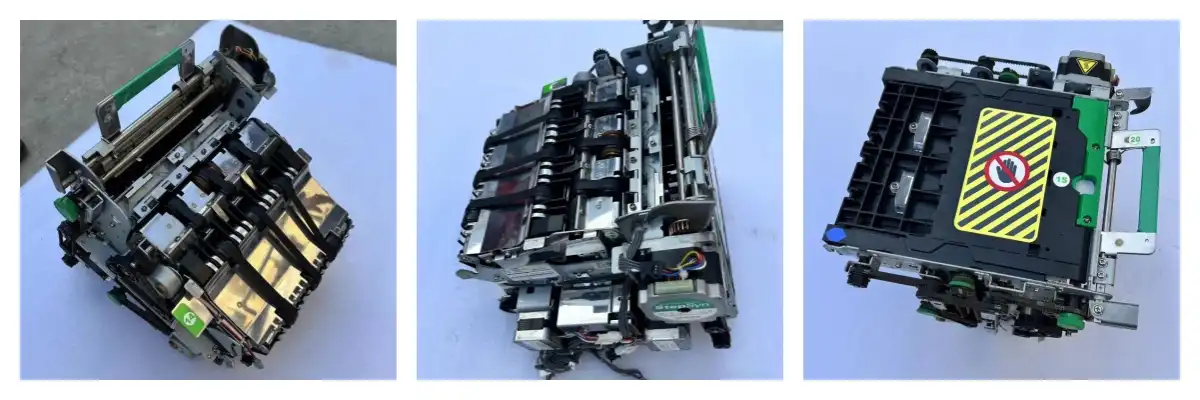
Understanding the G610 Recycler and Its Operational Role
For cash operations with a lot of cash, you need equipment that is fast, accurate, and reliable. The G610 Recycler meets this requirement with its modular design, which includes the bottom transport unit (KD02166-D959), the reject cassette, and the escrow device. These parts work together to accept bills of different denominations, make sure the bills are real using multiple sensors, and send notes to the right recycle cassettes or overflow boxes based on firmware settings that have already been set.
Core Functions in Cash Management Systems
The recycler takes bills through a slot-like opening and checks each one with magnetic, optical (infrared/ultraviolet), and thickness sensors. This multi-layer validation gives street-quality bills acceptance rates of over 99% and almost 100% accuracy in spotting fake bills.
Notes that pass approval are sent to the escrow area, which is a brief holding area where transactions can be canceled, before being stored permanently in recycle boxes. During dispensing cycles, the transport mechanism pulls notes from cassettes at speeds of 4 to 8 banknotes per second, keeping up this level of performance throughout continuous operation.
Integration With Existing Infrastructure
The G610's practical benefit comes from its compatibility. Standardized CEN/XFS drivers let the module work with both Fujitsu (part numbers 009-0025324/KD02155-D814) and NCR (009-0020383/009-0025029) systems, so it can be easily installed in a variety of ATM networks. The USB 2.0 and RS-232C interfaces make it easy to connect to host PCs, and firmware updates via USB connection make it easy to quickly adapt to new currency designs, which is very important when central banks release polymer notes or security-enhanced series.
The enclosed transport path keeps sensors from getting blocked in dusty stores, which has been a problem for people who run self-checkout lanes or kiosks in convenience stores for a long time. G610 Recycler integrates seamlessly into this enclosed design, ensuring that debris does not interfere with internal mechanisms. This design factor increases operating lifespan by lowering the number of repair visits, especially in places where environmental controls aren't possible.
Advantages of Using the G610 Recycler in High-Volume Cash Environments
Automated cash recovery increases efficiency, which directly leads to lower running costs. When cash is handled by hand, it usually takes more than one person to count, check, and balance the locker. The G610 gets rid of these steps that require a lot of work because it can handle payments and withdrawals from the same pool of cash without any help from a person.
Accuracy and Error Reduction
Human mistake in counting cash is about 1% to 2% on average in high-volume situations. This causes differences in the vault and long reconciliation processes. The recycler's sensor array checks each note on its own, keeping accurate records for each transaction cycle. Escrow adds a second level of security: customers check the amount of their deposit before it is accepted, and if there are any differences, the notes are automatically returned in the exact numbers they were deposited, instead of being replaced with a generic value.
Durability for Industrial Use
The G610 is built to last more than 100,000 operations before it fails, so it can be used continuously in environments that are open 24 hours a day, seven days a week. The main part that wears out is the friction pick rollers, which are rated for 200,000 to 500,000 note cycles depending on the quality of the currency. Replacement doesn't need any special tools, and technicians can get to clogged note paths quickly with green-labeled doors, so there is less downtime during busy times.
Cost-Effectiveness Compared to Competitor Models
Compared to the G700 series, the G610 has the same throughput but a smaller footprint, making it a good choice for installations with limited space. Modules from this generation use 15-20% less energy on average than modules from previous generations. This lowers the total cost of ownership over the usual 7–10 year deployment period. The ability to work with both Fujitsu and NCR brands makes inventory management even easier for service providers who manage ATM fleets from more than one vendor, since a single module type meets the needs of all platforms.
Purchasing and Procurement Considerations for the G610 Recycler
When procurement teams look at cash recycler modules, they focus on how reliable the supply chain is, how much expert help there is, and how clear the total cost is. Hong Kong RONG MEI TECHNOLOGY CO., LIMITED (RM) keeps G610 parts in stock, such as the 009-0025324 recycle cassette and the 009-0025045 GBRU cassette. Lead times are usually 15 to 20 working days from the time an order is confirmed.
Supply Chain and Availability
The RM building is 3,000 square meters and is ISO9001-2008 approved. It has mold rooms, injection molding departments, repair workshops, and quality control labs. This vertical integration makes sure that parts are always available, even if the original equipment maker (OEM) isn't making them at the right time. This is a huge benefit for banking institutions that keep ATMs running after the initial vendor support windows end. As of 2024, RM Product Specifications say that both brand-new and professionally refurbished units come in great shape and come with 30-day warranties and full online technical support.
Procurement Flexibility
Enterprise clients get discounts based on volume purchases and bulk purchase agreements that are made for network-wide deployments. Leasing arrangements help with tight budgets and allow for instant improvements to infrastructure. G610 Recycler fits well into these procurement models, offering a reliable hardware option that aligns with both bulk purchasing and leasing strategies. This is especially helpful for rural banks that have to manage capital spending cycles. Global buying teams get clear prices that include shipping costs. Options for sea, land, and air transportation balance the speed of delivery with the cost of freight.
After-Sales Support Infrastructure
Technical support starts before the installation. RM offers online and video remote help in a number of languages, taking operations teams through the steps of integration and setting up currency templates. This front-loaded support plan cuts down on on-site service calls, which is especially helpful in rural areas where the cost of sending a technician is too high. After deployment, operators can access troubleshooting guides that cover common error codes, and they can get answers to their questions in less than 24 hours.
The availability of genuine spare parts extends the module's life beyond the normal number of replacement cycles. Friction rollers, sensor assemblies, and transport belts can be shipped separately, which lets targeted repairs happen instead of full module swaps. This lowers the cost per incident while keeping uptime promises.
Best Practices for Maintaining and Troubleshooting the G610 Recycler
Preventive maintenance plans have a direct effect on how reliable a recycler is. Every six months or 50,000 rounds, whichever comes first, optical sensors and magnetic heads need to be cleaned with special cards that don't contain alcohol and compressed air. Paper dust buildup on transport belts and rollers needs to be checked regularly because it can cause slip-related jams in damp places. These standard steps, which are spelled out in user guides, are done by trained professionals and take about 30 minutes per unit.
Common Troubleshooting Scenarios
When a jam happens, certain error codes are sent that show where the problem is in the transport path. The chassis is made with non-tool access panels that let workers open certain areas and take out crumpled notes without taking the whole module apart. Safe-access zones are marked with green latches that help non-expert staff with recovery processes and keep sensor arrays from getting damaged by accident.
Safety and Compliance Standards
RoHS compliance meets the rules in European and North American markets and makes sure that Products are safe for the earth throughout their entire lifetime. Protection protocols against electrostatic discharge (ESD) during maintenance keep sensors from getting damaged, and grounding straps should be used for all procedures involving internal access. Operators are taught the right way to handle rejected notes, which could be fake bills that need to be stored safely until they can be inspected by law enforcement. This is done to make sure that anti-money laundering (AML) rules are followed.
How the G610 Recycler Compares to Other Cash Recyclers
Positioning in the market shows the G610's performance advantages over other models in key areas. G610 Recycler delivers these advantages consistently, with a processing speed of 4 to 8 notes per second that is the same as or faster than slot-type recyclers of the same size, and the noise level stays below 55 decibels, making it good for installations that people will be hearing and where background noise can affect the user experience.
Performance Benchmarking
Compared to the G700, the G610 gives up a little speed (about 10% less peak throughput) in exchange for better reliability in bad conditions. It has been proven through field deployments in retail self-checkout applications that the enclosed transport path lowers jam rates by 15–20% in dusty environments. Multi-denomination support for 100 to 500 notes per recycle cassette gives operators flexibility, and capacity configurations can be changed to fit transaction patterns. For example, locations with a lot of withdrawals should focus on loading notes in the most efficient way, while locations with a lot of deposits should make the most of the recycle capacity.
Market Positioning and Value Proposition
The G610 is made for mid-market setups where premium solutions aren't possible because of a lack of money ($5,000 per unit), but where dependability needs are higher than those of entry-level validators. This point of view is shared by independent ATM deployers (IADs), credit unions, and regional banks that run distributed networks but don't have the technology know-how of large banking institutions. Case studies from European CRM deployments show payback times of 18 to 24 months through lower CIT costs. Some operators reported 40% fewer cash refill trips after the implementation.
User Feedback and Proven Performance
Operators always say that the escrow function is what sets them apart, especially in crypto teller machines (BTMs) and bill payment kiosks, where being able to undo a transaction lowers the number of customer service calls. Being able to return exact placed notes instead of notes of equal value but different amounts makes it easier to settle disputes and builds trust in automated systems.
Conclusion
The G610 Recycler solves important problems in handling a lot of cash by recycling in a closed loop, validating data from multiple sensors, and being built to last. It can work with both Fujitsu and NCR platforms, is small, and has been tested to be reliable. This makes it a valuable asset for banks, retail stores, and IADs that want to cut costs while keeping service quality. Preventive maintenance plans and full technical support make sure that BTMs work well in a wide range of settings, from bank branches to convenience store BTMs. Supply lines that are clear, buying choices that are flexible, and after-sales support systems that are built for global operations all help procurement teams.
FAQ
What Denominations Can the G610 Recycler Process Simultaneously?
The recycler can handle different amounts because the cassette orders can be programmed. Through firmware configuration, each recycle cassette sets its own note values. Once a note is validated, the recognition unit sends it automatically to the right compartment. When cassettes are full or notes don't meet the requirements for recycling, the system sends them to overflow boxes so that it can keep running without any help from a person.
How Does the Unit Handle Humid Environments?
Humidity changes the coefficients of friction, which could lead to double-pick mistakes. The G610 has climate-adaptive tension change in the pick rollers, and in tropical operations, it is suggested that the rollers be calibrated every so often. Transport belts are made of materials that don't absorb water, and sensor housings have desiccant cartridges that can be changed during regular maintenance. This makes them more reliable in coastal or high-humidity areas.
Can Firmware Updates Address New Currency Series?
When the central bank redesigns money, the validation template needs to be updated. The G610 can have its firmware upgraded in the field via USB, and it only takes less than five minutes to flash new currency files into the device's memory. During recent polymer note transitions in Canada and Australia, this feature came in very handy because operators could update whole fleets directly without having to repair any modules.
Partner With RM for Reliable G610 Recycler Supply
When businesses upgrade their cash handling infrastructure, they need suppliers with both technical know-how and quick customer service. RM specializes in G610 Recycler modules and parts, and they keep a large stock of important parts like the KD02166-D959 lower transport assembly and 009-0025045 GBRU cassette. We have over 20 years of experience with financial equipment, so we can give you options that meet your business needs, whether you need to set up new CRM networks or extend the lifecycles of current ATMs.
Our ISO9001-2008-certified factory can make any changes you want, from changing the hardware to setting up the interface in multiple languages. This makes sure that it works perfectly with your cash management systems. We are a reliable source for banks, IADs, and service providers in North America, Europe, and the Asia-Pacific region for G610 Recyclers. We offer both brand-new and professionally restored units with 30-day guarantees. Lead times of 15 to 20 working days work with project schedules, and online and video remote help make launching as simple as possible.
Get in touch with Tony@atm-part.com to talk about your G610 Recycler needs, get detailed specs, or set up sample trials. You can look through our whole collection of ATM circuits and parts at atm-part.com. RM's supply chain stability and technical depth can help you reach your goals for handling a lot of cash.
References
1. ATMIA. (2023). Global ATM Market and Forecasts to 2028. ATM Industry Association.
2. ATM Marketplace. (2021). Cash Recycling Technology Advances in Self-Service Banking. ATM Marketplace Publications.
3. Federal Financial Institutions Examination Council. (2019). Bank Secrecy Act/Anti-Money Laundering Examination Manual. FFIEC.
4. Fujitsu. (2020). G610 Series Technical Documentation and Service Manual. Fujitsu Limited.
5. RBR. (2022). Global ATM Market and Forecasts to 2027. Retail Banking Research.
6. RM Product Specifications. (2024). G610 Recycler Module Technical Datasheet. HONGKONG RONG MEI TECHNOLOGY CO., LIMITED.
Learn about our latest products and discounts through SMS or email