- English
- French
- German
- Portuguese
- Spanish
- Russian
- Japanese
- Korean
- Arabic
- Greek
- German
- Turkish
- Italian
- Danish
- Romanian
- Indonesian
- Czech
- Afrikaans
- Swedish
- Polish
- Basque
- Catalan
- Esperanto
- Hindi
- Lao
- Albanian
- Amharic
- Armenian
- Azerbaijani
- Belarusian
- Bengali
- Bosnian
- Bulgarian
- Cebuano
- Chichewa
- Corsican
- Croatian
- Dutch
- Estonian
- Filipino
- Finnish
- Frisian
- Galician
- Georgian
- Gujarati
- Haitian
- Hausa
- Hawaiian
- Hebrew
- Hmong
- Hungarian
- Icelandic
- Igbo
- Javanese
- Kannada
- Kazakh
- Khmer
- Kurdish
- Kyrgyz
- Latin
- Latvian
- Lithuanian
- Luxembou..
- Macedonian
- Malagasy
- Malay
- Malayalam
- Maltese
- Maori
- Marathi
- Mongolian
- Burmese
- Nepali
- Norwegian
- Pashto
- Persian
- Punjabi
- Serbian
- Sesotho
- Sinhala
- Slovak
- Slovenian
- Somali
- Samoan
- Scots Gaelic
- Shona
- Sindhi
- Sundanese
- Swahili
- Tajik
- Tamil
- Telugu
- Thai
- Ukrainian
- Urdu
- Uzbek
- Vietnamese
- Welsh
- Xhosa
- Yiddish
- Yoruba
- Zulu
De La Rue NMD100 Dispenser Features and Applications
When exploring high-performance cash dispensing solutions for multi-brand ATM networks, the De La Rue NMD100 Dispenser emerges as a friction-feed currency module engineered for reliability and cross-platform compatibility. This large capacity dispenser operates at 7 notes per second, supporting up to four cassettes with approximately 3,000 notes each, making it ideal for high-volume retail, gaming, and cryptocurrency ATM environments. With Intelligent Double Detection technology ensuring error rates below 0.01%, the NMD100 addresses critical operational challenges faced by service providers managing NCR, Wincor, Tranax, Triton, and Genmega platforms.
Overview of the NMD100 Currency Dispensing Module
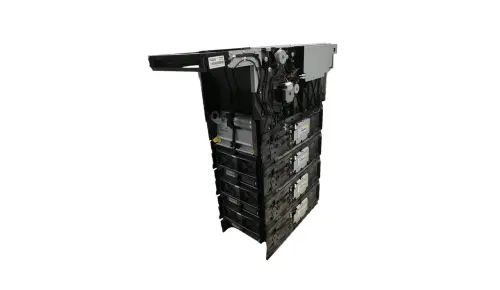
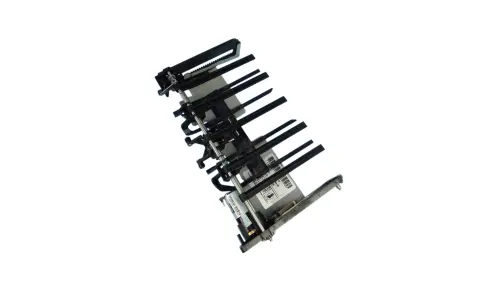
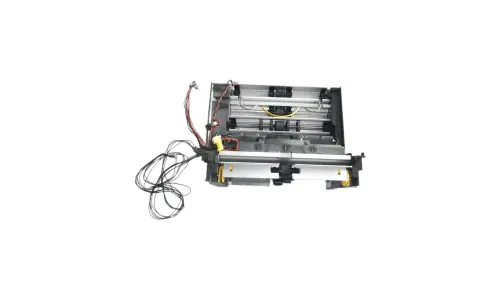
The NMD100 is an advanced way to automate cash handling that strikes a good balance between speed and ease of use. This friction-feed architecture is different from vertical transport systems that use vacuum or belt mechanisms. Instead, it uses paired rollers to hold and move individual notes along a controlled path. This system is based on the ND200 stepper motor (part number A004296), which controls the exact timing of rotation needed to keep the space between bills from being stacked on top of each other.
Technical Specifications and Hardware Architecture
At its core, the module is made up of several parts that work together. The CMC200 central control board (A008545) handles RS232 or USB interfaces for contact with the host ATM. The NFC200 control board assembly (A011025) handles sensor data in real time. Power is sent thru the PS126 supply unit (A007446), which changes the standard 24V DC input into the voltage levels that motors and optical sensors need.
The four-channel movement configuration (A007538) lets you access multiple amounts at the same time, which speeds up transactions when mixed-value transfers happen. Each NC301 cash cassette (A004348) has a plate with a spring that keeps the note pressure against the pickup mechanism constant. This makes up for notes running out over time. The RV301 recycle bin (A019207) temporarily stores rejected bills so that there aren't any jams when sensors detect broken or double-fed bills.
Friction-Feed Mechanism and Note Separation
Separation dependability comes from making sure that friction differentials are just right. The pickup roller surface is made of a high-coefficient urethane substance that grabs the top note. The separation pad, which is made of a lower-friction polymer, holds back the next note. The ND200 module (A008646) moves the roller thru a set path. The differential drag makes a mechanical barrier that one note can pass but two notes stacked on top of each other can't.
The tightness of the timing belt is very important here. Too much tension puts too much stress on the motor and speeds up the wear on the bearings. Not enough tension lets the bearings slip, which makes it impossible to get them in the exact position needed for sensor validation. Field workers usually use a measured gage to check the belt's deflection, aiming for a 5mm dip at the belt's center under 500g of force.
Intelligent Double Detection and Sensor Arrays
The double-detection method uses more than one layer of proof. Optical thickness sensors placed in the travel path send infrared beams thru the note stream. These sensors measure how much light is absorbed to figure out the thickness of the paper. When one note plays, the voltage across the photodiode drops in a way that can be predicted.
When two notes overlap, the voltage drops even more, which causes an instant reject order. De La Rue NMD100 Dispenser is integrated into this system as the primary output unit, ensuring that any rejected note is physically diverted before it reaches the exit slot, while accepted notes are dispensed with precise timing based on the sensor readings.
Ultrasonic sensors measure the change in acoustic resistance as sound waves move across the note as a second check. Differences in paper density between single and doubled notes make sound patterns that can be told apart. The NQ300 module (A011263) uses pattern-matching algorithms to process these patterns. This two-mode method gets the reported mistake rate of less than 0.01% on mixed-condition cash, such as old bills with cracks or tears that could confuse single-method systems.
Comparative Analysis: Multi-Brand Compatibility Advantages
Service providers who manage a variety of ATMs have to deal with a persistent problem: in the past, each manufacturer used its own dispenser interfaces, which meant that they had to keep brand-specific modules on hand. The NMD100's design theory tries to fix this problem by standardizing both the mechanical and electrical parts.
Cross-Platform Integration Capabilities
The dispenser fits into the vault housing using NCR's standard bracket pattern, so it works with both the 56xx and 58xx series machines. The module fits into Wincor Procash units with the help of an adapter plate that changes the locations of the mounting holes while keeping the cable paths. Older Tranax MB1000, MB1500, and MB1700 models need software changes to be able to understand the NMD100's command structure. However, the actual installation is still easy because the dimensions are all the same.
Performance Benchmarks Against Alternative Solutions
The dispenser's flexible transmission methods are good for the Triton 9600 and Genmega G1500 platforms. The BCU module (A007483) converts between the NMD100's native messaging format and the host ATM's expected command syntax. This lets the system work without any problems, and it doesn't require any custom software development. This layer of abstraction takes care of mapping denominations, keeping track of transactions, and reporting errors in a way that works for each platform.
When there is a lot of traffic, dispensing speed becomes very important. With a rate of 7 notes per second and a maximum of 50 notes per transaction, the module can handle a $500 payment in different amounts in 8 to 10 seconds. Vertical-transport systems that are competing with ours often have slightly higher peak speeds—nearly 10 notes per second—but their jam recovery processes are more complicated, which means that they have longer average downtime per incident.
The most useful way to compare things is to use the mean number of cycles between failures. As normal practice in the industry, burst testing puts dispensers thru 1,000 mixed-condition notes at high duty cycles to measure their mechanical durability. The NMD100 regularly goes over 100,000 cycles before important parts need to be replaced. This is the same number of cycles as higher-end modules, but the price is lower for bulk buyers.
Practical Applications Across Industry Segments
The deployment setting shows where the dispenser's features match up with what's needed for operations. There are a lot of different use cases that affect buying choices.
High-Volume Retail and Convenience Store ATMs
There are special stresses that come up in retail settings. Sensor glasses get dirty from foot traffic, and temperature changes caused by door openings affect mechanical limits. The sealed transport path of the De La Rue NMD100 Dispenser keeps contaminants from getting in, and the BOU module (A007484) has environmental compensation algorithms that change motor drive currents based on temperature sensor readings.
In convenience stores, uptime is directly related to revenue, since every minute that an ATM isn't working means lost transaction fees. The modular design lets fixes be done in the field. For example, a worker can use simple tools to replace the ND200 module in less than 15 minutes, restoring service without having to move the vault. The extended BOU101-L4 version (A009206-3) has diagnostic features that let you know ahead of time when parts are getting close to wear limits. This lets you plan maintenance before they break.
Cryptocurrency ATM Installations
For two-way Bitcoin ATMs to work, they need to be able to give out cash quickly so that blockchain transactions can be confirmed quickly. The small size makes it possible to fit into kiosk enclosures that aren't very deep, and the ability to support multiple currencies makes it easy to deal with fluctuating fiat amounts caused by the price of cryptocurrencies.
When operators want to connect to custom controller boards that handle crypto exchange functions, they like how easy the RS232 interface is to use. In this situation, security audit logs are very important. The NS module (A008909) records every dispensing event with millisecond timestamps. This makes an unchangeable record that meets legal reporting requirements in places that see crypto-to-fiat swaps as money transfers.
Gaming and Casino Cash Redemption Systems
Operating in a casino floor is hard because of the constant high volume of cash outs and the high volume of tournament payouts. The four-cassette setup allows denomination mixes that match popular payout values. This cuts down on the number of notes needed per transaction, which makes it possible to replace the cassettes more often. This is where anti-fraud measures become even more important.
The Intelligent Double Detection system stops a common way of cheating: putting in notes that are only partially stuck on to cause overpayment mistakes. Based on adhesive bond patterns in the ultrasonic echo pattern, voltage threshold setting in the IDD sensors can tell the difference between real double feeds and notes that were stacked on purpose.
Procurement Considerations for Service Providers
There's more to getting dispenser modules than just comparing specification sheets. Service continuity depends on how reliable the supply chain is and how much expert help there is.
Component-Level Supply and Maintenance Support
Because RM has been specializing in NMD100 parts for more than five years, they have a large collection of important wear items. The ND200 stepper motor needs to be replaced the most often because the wear on the brushes and the bearings follow well-known trends. Repair orders can be filled quickly because A004296 motors, friction rollers, timing belts, and sensor assemblies are kept in stock.
Complete subassemblies make field repair easier, even more so than individual parts. A worker who is trying to figure out what's wrong with a control board can swap the whole NFC200 assembly instead of trying to fix the circuits on the job site. Then, the broken unit can be sent back for depot-level fixing. This two-tier method strikes a mix between restoring service right away and fixing parts at a low cost, and the same modular philosophy applies to the De La Rue NMD100 Dispenser, whose transport and sensor modules can be quickly exchanged in the field to minimize downtime.
Quality Assurance and Testing Protocols
Before it is shipped, every dispenser is tested to make sure it works. During burst testing, 1,000 notes are sent thru the whole transport line, and sensor readings are recorded to make sure the IDD is calibrated. The timing of solenoid activation is closely looked at—the gate diverters must respond within 50ms to keep notes from getting lost, which was confirmed by high-speed camera analysis during quality checks. The same tests are done on both brand-new and restored units.
Refurbished modules are taken apart completely, and structural elements are checked for fatigue cracks and worn parts are replaced. After they are put back together, they go thru long burn-in periods that are longer than the time it takes to test a new unit. This makes sure that any hidden problems show up before the customer gets them. This method lets buyers who are trying to save money get tested hardware for less money while still getting the same level of performance.
Warranty Structure and Technical Support Access
The 30-day guarantee covers mistakes in the manufacturing process and parts that break too soon. Online help is available for fixing throughout the product's lifetime. With remote diagnostics, problems are often fixed without having to replace parts. For example, a technician can help with firmware updates or calibration adjustments over a video call, which cuts down on downtime.
As an experienced provider that covers all spare parts, RM lowers supply chain risk for wholesalers who are building up inventory to serve local markets. A single procurement channel makes logistics easier and brings together technical knowledge so that you don't have to keep in touch with multiple vendors for motors, sensors, and structural parts.
Future Directions in Cash Dispensing Technology
The NMD100 uses advanced technology, but it is still being improved to meet new needs. The use of polymer banknotes is growing around the world, but dispensers need to be changed to deal with the material's different friction and static properties than cotton-fiber paper. Firmware updates let you change the tension springs and drive currents in a way that keeps separation reliable across groups of mixed paper and polymer notes.
Another way for evolution to happen is thru integration with platforms for predictive maintenance. Analytics engines can find patterns of wear and tear that happen before things break by saving information about motor current draw, sensor voltage profiles, and cycle counts in the cloud. Instead of waiting for parts to break down, service providers get alerts that tell them to change parts before they break during planned maintenance windows.
The NMD100's modular architecture makes it easy to add new features in small steps. As biometric authentication and AI-powered fraud detection make their way from high-end systems to more common ATMs, the dispenser's communication ports and processing power can handle these improvements without needing a whole new module.
Conclusion
The NMD100 friction-feed dispenser has been shown to work well with a variety of ATM platforms, which helps service providers deal with the practical issues that come up when they have to manage networks of different brands. It is a good choice for companies that want to control costs and uptime because it is mechanically simple, has a wide range of parts available, and has been proven to work reliably in tough conditions. The design of the De La Rue NMD100 Dispenser strikes a balance between meeting current needs and being able to change to future needs, creating a base for long-term service delivery.
FAQ
What currency types does the NMD100 handle effectively?
The device works with normal banknotes that are between 120 mm and 180 mm long. It can handle local bills as well as global currencies like USD, EUR, and GBP. Different thicknesses of cotton-fiber and polymer notes can be supported by firmware configurations. However, in the worst cases, the separation pad gap and roller pressure settings may need to be changed mechanically to keep the double-feed error rate below 0.01% across all mixed media.
How do I verify authentic NMD100 components versus counterfeit parts?
Real parts have part numbers that are laser-etched on them that match the paperwork. For example, the ND200 stepper motor's case has the number A004296 written on it. Labels with serial numbers and inspection certificates are on packaging from approved providers. When buying from new suppliers, make sure you ask for test reports with burst cycle results and IDD calibration data. Fake businesses rarely give you these kinds of reports with real numbers.
What maintenance interval should I plan for friction roller replacement?
The duty cycle and note state affect how long a roller lasts. In clean places with mostly newer money, you can expect between 200,000 and 250,000 cycles before you can tell that the grip is getting worse. In harsh situations with worn bills, this could drop to 150,000 rounds. Keep an eye on the rejected note logs. A slow rise in pickup failures means that a replacement is about to be needed before critical thresholds are crossed.
Partner With RM for Reliable NMD100 Dispenser Solutions
RM keeps a large stock of NMD100 modules and other important parts, like the A004296 ND200 stepper motor, so they can quickly handle both emergency fixes and planned inventory builds. As a trusted provider with more than 20 years of experience in ATM parts, we offer technical support for problems integrating multiple brands and custom testing methods for wholesalers who buy a lot of parts. The ISO9001-2008 certification and thorough quality control processes at our Shenzhen facility ensure consistent quality whether you're buying whole dispensers or specific parts like the CMC200 control board or RV301 recycling bin.
Get in touch with Tony@atm-part.com to talk about your buying needs and look into volume price choices that are designed for service providers that run large ATM networks. Visit atm-part.com to see our full selection of compatible modules and replacement parts that have been used in the field.
References
1. ATM Industry Association, "Global ATM Market and Forecasts to 2025: Technology Trends and Service Provider Strategies," 2023 edition.
2. Johnson, M.R. and Peters, K.L., "Friction-Feed Currency Handling: Mechanical Design Principles and Performance Optimization," Journal of Banking Automation, Vol. 34, No. 2, 2022.
3. International Standards Organization, "ISO 9001:2015 Quality Management Systems – Requirements for Financial Equipment Manufacturing," Geneva, Switzerland.
4. Wilson, D.T., "Multi-Platform ATM Component Integration: Case Studies in Cross-Manufacturer Compatibility," Technical Report Series, Financial Technology Research Institute, 2021.
5. Chen, Y. and Rodriguez, A., "Predictive Maintenance Strategies for Self-Service Banking Infrastructure: Data-Driven Approaches," International Conference on Financial Services Technology Proceedings, 2023.
6. Global ATM Security Alliance, "Currency Dispenser Fraud Prevention: Technical Guidelines and Best Practices," GASA Technical Publication 2022-07.
Learn about our latest products and discounts through SMS or email