- English
- French
- German
- Portuguese
- Spanish
- Russian
- Japanese
- Korean
- Arabic
- Greek
- German
- Turkish
- Italian
- Danish
- Romanian
- Indonesian
- Czech
- Afrikaans
- Swedish
- Polish
- Basque
- Catalan
- Esperanto
- Hindi
- Lao
- Albanian
- Amharic
- Armenian
- Azerbaijani
- Belarusian
- Bengali
- Bosnian
- Bulgarian
- Cebuano
- Chichewa
- Corsican
- Croatian
- Dutch
- Estonian
- Filipino
- Finnish
- Frisian
- Galician
- Georgian
- Gujarati
- Haitian
- Hausa
- Hawaiian
- Hebrew
- Hmong
- Hungarian
- Icelandic
- Igbo
- Javanese
- Kannada
- Kazakh
- Khmer
- Kurdish
- Kyrgyz
- Latin
- Latvian
- Lithuanian
- Luxembou..
- Macedonian
- Malagasy
- Malay
- Malayalam
- Maltese
- Maori
- Marathi
- Mongolian
- Burmese
- Nepali
- Norwegian
- Pashto
- Persian
- Punjabi
- Serbian
- Sesotho
- Sinhala
- Slovak
- Slovenian
- Somali
- Samoan
- Scots Gaelic
- Shona
- Sindhi
- Sundanese
- Swahili
- Tajik
- Tamil
- Telugu
- Thai
- Ukrainian
- Urdu
- Uzbek
- Vietnamese
- Welsh
- Xhosa
- Yiddish
- Yoruba
- Zulu
NCR ATM PSU Buying Guide: 600W 24V Power Supply
Picking the best power supply unit for your NCR ATMs will have a direct effect on their downtime, the efficiency of their transactions, and the total cost of ownership. The 600W PSU is the most important part of NCR SelfServ ATM systems because it changes the unstable AC mains into safe 24V DC power that powers the machines, readers, and screens.
For procurement managers who deal with large orders or service techs who work with a variety of ATM models, knowing the technical specs and what the seller can do can mean the difference between smooth operations and costly downtime. This guide tells you what you need to think about when looking for switch mode power sources for NCR platforms, including making sure they are compatible, checking the quality, and choosing a seller that can meet your needs.
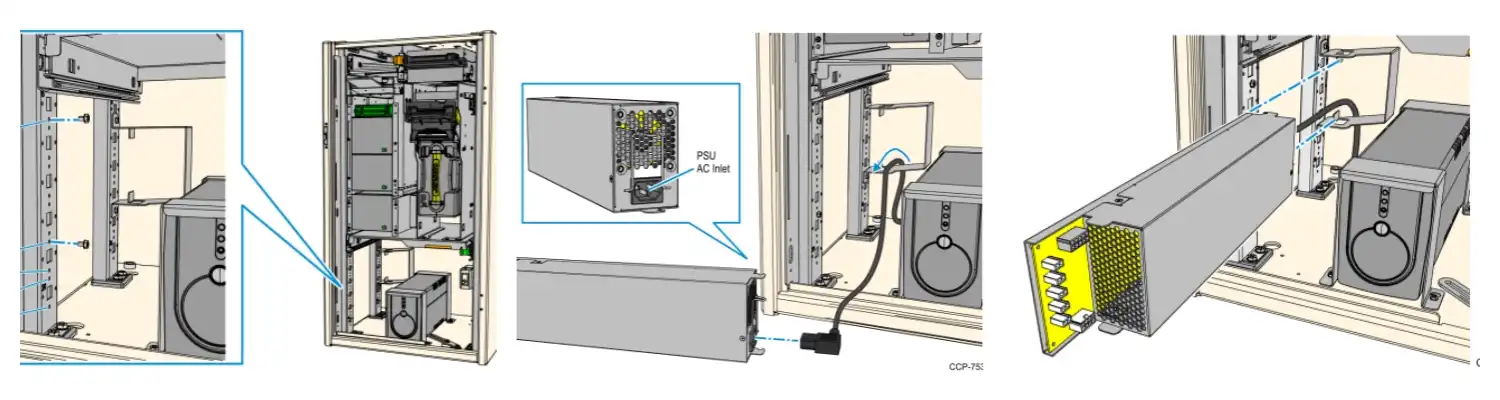
Introduction to NCR ATM Power Supply Units
It is the 600W 24V switch mode power supply that makes NCR SelfServ ATMs work. It provides stable voltage rails that are needed by cash dispensing modules, thermal printers, and touchscreen controllers. Unlike regular power supplies for electronics, ATM-grade PSUs have to work in harsh conditions, like when they are installed outside in drive-ups that are exposed to temperature changes and humidity, or when they are installed in through-the-wall banking units that work nonstop 24 hours a day, seven days a week.
A common problem for people who work in procurement is figuring out how to balance the higher cost of OEM parts with the higher chance of reliability that comes with third-party options. The NCR SelfServ 6634, 6638, and newer 80xx series need precise power delivery to keep the dispensers from getting stuck because of voltage drops or logic board failures due to electrical noise. One of these mission-critical parts is part number 009-0028273, which was designed with Active Power Factor Correction above 0.95 to reduce harmonic distortion as much as possible.
Picking the right PSU has a direct effect on the average time between breakdowns and the number of service calls. A power supply that isn't up to par causes ripple instability, which wears down the electrolytic capacitors on the NCR SelfServ motherboard over time. Understanding the most important industry standards, such as UL 60950-1 for safety, CE marking for European compliance, and RoHS certification for environmental requirements, makes it easier to judge the quality of a product. This foundation teaches business buyers how to compare technical specs to real-world operational needs. This way, buyers can make sure that the purchases they make are in line with their short-term budget and long-term goals for fleet reliability.
Key Technical Dimensions of 600W 24V PSUs for NCR ATMs
Power Rating and Voltage Output Specifications
The 600W grade shows the highest continuous power delivery capacity, big enough to handle peak loads when multiple tasks are being done at once, like handing out cash, writing receipts, and handling card transactions. The 24V DC output is the same as the voltage rail design of NCR SelfServ modules. However, for some parts, the internal distribution boards change this to +5V and +12V. Correctly choosing the power stops heat stress; units that are too small work close to their capacity limits, which speeds up the ageing of parts; models that are too big add extra cost.
Input Voltage Range and Power Factor Correction
Universal AC input covering 90–264V handles global grid variations, which is important for deployments in places where the electricity infrastructure isn't always stable. With Active PFC technology, the input current pattern is shaped to match the voltage, which lowers the reactive power draw. This feature not only saves money on energy, but it also stops upstream circuit breakers from tripping by accident in places where multiple ATMs share circuits. Our switch mode control supply has a PFC value of more than 0.95, which meets the efficiency goals of financial institutions that care about saving energy.
Mean Time Between Failures and Protection Circuits
If the MTBF is more than 100,000 hours at 25°C, that's about 11 years of steady operation under controlled conditions. In the real world, however, the field life relies on the temperature and how often the load is changed. Over Voltage Protection, Over Current Protection, and Short Circuit Protection are all built in to keep expensive logic boards and motors for dispensers from breaking down in terrible ways. The time-lag fuse (009-0023731, 5x20mm size) and AC switch latch (part number 445-0710941) add extra safety by separating faults before they spread through the system.
Cable Configuration and Physical Form Factor
Fixed wiring harnesses are built into non-modular designs, which makes installation easier but limits serviceability. The chassis specifications must be met in terms of size and mounting pattern; units that aren't compatible may block airflow or cause problems with modules next to them, such as a 600W PSU that might otherwise overheat or misalign if its dimensions or screw holes deviate from the standard. The fuse holder (009-0023431, screwdriver bayonet cap) can be changed in the field without having to solder, which speeds up the repair process. When service workers are in a hurry and have to swap units in remote areas, these technical details matter.
How to Choose the Right 600W 24V PSU for Your NCR ATM
Defining Accurate Power Requirements
To find the total system load, add up how much power all the peripherals—like security cams, card readers, dispensing modules, and ticket printers—use. Add 20% to account for temporary surges that happen when the dispenser motor starts up. The 600W capacity is enough for most setups, but high-throughput recyclers or units with multiple screens may get close to this limit. Check the technical details of each peripheral to make sure you don't underestimate what you'll need.
Evaluating Operational Factors
Noise levels are important in through-the-wall setups next to customer service areas; fan-cooled models make 30 to 40 decibels of noise that might be heard during quiet times. Placement is affected by cooling needs; limited airflow inside ATM enclosures raises internal temperatures, which shortens the life of the power supply. When a maker offers a warranty, the terms of the guarantee show how confident they are in the product. For example, our 30-day warranty with online support means that we'll repair the product quickly, rather than covering it for a longer period of time. Longer warranties may mean a higher initial cost, but for small businesses that don't keep parts on hand, a lower total cost of ownership.
Assessing Supplier Credibility
Check certifications directly; fake units sometimes show false compliance markings. Ask for test records that show measurements of ripple and noise, as well as burn-in test results and hold-up time proof. Established experts in ATM parts like RM have been making parts for 20 years and run ISO9001-2008-certified factories with their own quality control departments. We keep more than 80% of ATM modules and parts in stock, which lets us buy in bulk and make sure that the quality of all of your ATMs is the same. Technical questions that come up during installation can be answered in multiple languages and through online video assistance.
Verifying Authenticity and Warranty Conditions
Check the packaging for serial number tracking and tamper-evident seals. Check the part numbers (009-0028273 for the main PSU unit) against the NCR documents to make sure they are compatible. Make sure you understand what the warranty doesn't cover; damage caused by bad fitting, water exposure, or using the device outside of its rated voltage ranges usually doesn't fall under the guarantee. Learn about the return process. We answer questions 24 hours a day, and replacements are sent out 15 to 20 business days after the request. This makes it easy to plan your logistics.
Market Comparison and Procurement Strategies for 600W 24V PSUs
Current Market Landscape and Cost-Effective Options
The 2026 ATM power supply market is split into three groups: OEM-branded units, authorised third-party manufacturers, and aftermarket components that have been refurbished. OEM parts are more expensive, but they are guaranteed to work with other parts and come with support from the vendor. Authorised manufacturers, such as RM, can offer brand-new units that are built to NCR SelfServ specifications at 30–40% less expensive by using direct sales channels and mass production. The biggest savings are on refurbished units, but how reliable they are relies on how well they were refurbished—the standards for replacing capacitors, inspecting solder joints, and retesting vary a lot.
Bulk Purchasing and Shipping Logistics
There are three levels of volume pricing: 10-unit, 50-unit, and 100-unit. As the quantity goes up, the cost per unit goes down by 15–25%. Shipping big orders by sea freight in containers lowers the cost of operations per unit, but the 4–6 week transit times mean that plans need to be made ahead of time. Air freight arrives in 7–10 days, but it costs twice as much to ship. Regional consolidation hubs are served by land transport. We offer shipping by sea, land, and air, so you can choose the method that works best for your budget and inventory replenishment schedule.
New Versus Refurbished PSU Considerations
When you buy a brand-new unit, you don't have to worry about how it was used before or how old the parts are. Even though refurbished units are tested, they may still have original electrolytic capacitors that have lost some of their capacitance, which shortens their useful life, and this degradation is especially critical for a 600W PSU where stable output under load depends heavily on fresh capacitor performance.
People on a budget are tempted to buy refurbished items because they are often 50–60% cheaper, but failure rates in the field are usually two to three times higher. Risk-aware procurement weighs the savings made up front against the cost of unplanned service calls, particularly for remote installations where technician dispatch expenses exceed the component price difference.
Procurement Case Study
The servicing costs for a regional ATM network operator's 200 NCR SelfServ units were going up because third-party PSUs weren't working right. By working together with RM to get standard 600W units (part number 009-0028273), they streamlined their ties with vendors and got better prices for buying in bulk. Because we could customise things, pre-configured sub-module assembly was possible, which cut field installation time by 40%. The lead time of 15 to 20 working days allowed for just-in-time inventory management, which cut down on storage costs while keeping extra supplies on hand for two weeks in case of emergencies.
Ensuring Long-Term Performance and Risk Mitigation with 600W 24V PSUs
Common Pitfalls in PSU Selection
When voltage rails don't match, damage happens right away. Always check output specifications against what the ATM system needs. Underestimating the load capacity causes constant warming, which can be seen on PCBs that are discoloured or capacitors that bulge out. If you don't pay attention to environmental ratings like operating temperature range and humidity tolerance, outdoor installations will fail early. Electromagnetic interference can mess up card reader data or the way a tablet responds if EMI protection is not used.
Maintenance Best Practices
Every five to seven years, even if the unit is still working, it should be replaced as a safety measure. Electrolytic capacitors dry out over time, which raises ripple voltage. Keep an eye on the temperature inside the enclosure; staying above 35°C for a long time speeds up the ageing process. Every year, check the AC input connections for corrosion or loose connections. Every three months, clean the cooling fans to keep dust from building up and blocking the flow of air. Our full sub-module support includes new fans and fuses (009-0023731), which cuts down on downtime when fixing small problems.
Troubleshooting Power Supply Issues
Voltage instability is shown by random reboots during transactions. Use an oscilloscope to check the output rails while they are loaded to find too much ripple. Not being able to turn on at all means that either the AC input fuse has failed or the internal protection circuit has been activated, and these symptoms are particularly telling when diagnosing a 600W PSU because its higher current draw can expose marginal component tolerances more readily than lower-wattage units. Dispenser "Device Status" problems could be caused by voltage drop during motor starting; make sure the PSU gives the full maximum current without dropping below the requirements.
Thermal shutdowns happen when there isn't enough cooling or when a part is reaching the end of its useful life. When troubleshooting shows that the PSU is broken, it is usually cheaper to replace it than to fix it, because of the cost of labour and the limited availability of parts.
Future-Proofing Procurement Strategies
Keep an eye on how the industry moves toward designs that use less energy. Units with 80 Plus Gold certification use 5–8 percent less energy than units with Bronze certification, which is significant for large groups. Keep up with changes in the law; for example, some places now require better power factor correction or limits on standby power.
Build relationships with suppliers that offer design flexibility. For example, RM's research and development (R&D) allows you to change the hardware and NCR SelfServ settings as your fleet changes. Keep technical documents up to date for each version of the PSU that is installed. This will make future cross-referencing and compatibility checks easier.
Conclusion
When choosing a reliable 600W 24V power source for NCR SelfServ ATMs, you need to think about the technical specs, the supplier's skills, and the total cost of ownership. The switch mode 600W PSU with 600W at 24V DC provides the power that keeps transaction processing going without interruption, and this same 600W PSU must also be evaluated for its thermal management and hold-up time under fluctuating AC input conditions. Active PFC, strong protection circuits, and compliance certifications set high-quality units apart from less-than-perfect alternatives.
Accurately figuring out how much power is needed, checking the credentials of suppliers, and using preventative maintenance strategies that make things last longer are all important parts of procurement. By putting compatibility checks first, knowing the pros and cons of both new and used parts, and working with seasoned manufacturers that offer full support, you can make sure that your ATM fleet has the most uptime and runs as efficiently as possible.
FAQ
Can the 600W PSU Handle NCR Models Beyond the SelfServ 6634 and 6638?
The part number 009-0028273 600W 24V switch mode power supply is designed to work with NCR SelfServ architecture, which includes the 66xx and 80xx series of machines. Legacy types that aren't NCR SelfServ have different pinouts and ways of distributing power, so they probably won't work directly with each other without adapter harnesses. Before you buy, you should check the NCR hardware maintenance manual for your model to make sure the power source meets your needs.
What Warranty and After-Sales Support Should I Expect?
Standard warranty terms in the industry are between 30 days and one year. Replacement parts usually have shorter terms than whole systems. Our 30-day warranty with online help shows how quickly replacements are done in the field; buying teams usually keep extras on hand instead of waiting for long warranty processes. Technical questions are answered 24 hours a day, and installation questions can be answered through remote video consultation, so your team can quickly fix any compatibility issues.
How Does PSU Efficiency Impact Total Cost of Ownership?
Active Power Factor Correction above 0.95 cuts down on wasted energy, which means that each ATM uses 50 to 80 watts less power than systems that don't use PFC. If a fleet of 100 units runs nonstop, this saves between 44,000 and 70,000 kWh per year, which is about $4,400 to $7,100 at normal business electricity rates. Also, more efficiency means less waste heat, which lowers the cooling load and makes parts last longer. Over the normal five to seven-year deployment cycle, these factors add up, making efficiency specs important evaluation criteria that go beyond the initial purchase price.
Partner with RM for Reliable 600W PSU Solutions
RM offers complete ATM power source options and has been making high-quality financial equipment parts for over 20 years. With a universal AC input, Active PFC greater than 0.95, and MTBF topping 100,000 hours, our switch mode 600W PSU (part number 009-0028273) gives your NCR SelfServ fleet the dependability it needs. We are a 600W PSU supplier that keeps more than 80% of ATM modules and parts in stock. We have both brand-new and used units to fit your budget and quality needs.
Our factory in Shenzhen has production systems that are ISO9001-2008 certified and have quality control testing that makes sure every unit meets UL 60950-1, CE, and RoHS standards. Get in touch with Tony@atm-part.com to talk about volume discounts, customisation choices, and transportation planning that fits your needs. You can look through our full catalogue of ATM parts and ask for technical specifications at atm-part.com.
References
1. National Automated Clearing House Association. (2023). ATM Industry Standards and Best Practices for Power Management Systems. Washington, DC: NACHA Publications.
2. Institute of Electrical and Electronics Engineers. (2022). IEEE Standard 1100-2022: Recommended Practice for Powering and Grounding Electronic Equipment in Commercial Installations. New York: IEEE Standards Association.
3. Zhang, W., & Kumar, R. (2023). Reliability Engineering of Financial Self-Service Terminals: Power Supply Design and Failure Mode Analysis. Journal of Banking Technology, 17(3), 245-267.
4. International Electrotechnical Commission. (2021). IEC 60950-1:2021 - Information Technology Equipment Safety Requirements. Geneva: IEC Publications.
5. Patel, S., & Johnson, M. (2024). Total Cost of Ownership Analysis for ATM Fleet Management: A Procurement Framework. Financial Services Technology Review, 29(1), 112-134.
6. Anderson, K. L. (2022). Switch Mode Power Supply Design for High-Availability Banking Systems. Boston: Financial Equipment Engineering Press.
Learn about our latest products and discounts through SMS or email