- English
- French
- German
- Portuguese
- Spanish
- Russian
- Japanese
- Korean
- Arabic
- Greek
- German
- Turkish
- Italian
- Danish
- Romanian
- Indonesian
- Czech
- Afrikaans
- Swedish
- Polish
- Basque
- Catalan
- Esperanto
- Hindi
- Lao
- Albanian
- Amharic
- Armenian
- Azerbaijani
- Belarusian
- Bengali
- Bosnian
- Bulgarian
- Cebuano
- Chichewa
- Corsican
- Croatian
- Dutch
- Estonian
- Filipino
- Finnish
- Frisian
- Galician
- Georgian
- Gujarati
- Haitian
- Hausa
- Hawaiian
- Hebrew
- Hmong
- Hungarian
- Icelandic
- Igbo
- Javanese
- Kannada
- Kazakh
- Khmer
- Kurdish
- Kyrgyz
- Latin
- Latvian
- Lithuanian
- Luxembou..
- Macedonian
- Malagasy
- Malay
- Malayalam
- Maltese
- Maori
- Marathi
- Mongolian
- Burmese
- Nepali
- Norwegian
- Pashto
- Persian
- Punjabi
- Serbian
- Sesotho
- Sinhala
- Slovak
- Slovenian
- Somali
- Samoan
- Scots Gaelic
- Shona
- Sindhi
- Sundanese
- Swahili
- Tajik
- Tamil
- Telugu
- Thai
- Ukrainian
- Urdu
- Uzbek
- Vietnamese
- Welsh
- Xhosa
- Yiddish
- Yoruba
- Zulu
Glory MiniMech Dispenser Installation and Compatibility Guide
If you manage ATM networks or operate cash kiosks, you already know how much a single dispensing failure can cost. The Glory MiniMech dispenser is the compact, friction-feed cash dispensing module purpose-built for exactly these environments — retail ATMs, crypto kiosks, and back-office cash management systems. This guide covers everything from installation steps and compatibility checks to maintenance schedules and sourcing options, so your team can deploy with confidence and keep uptime where it belongs: above 99.5%.
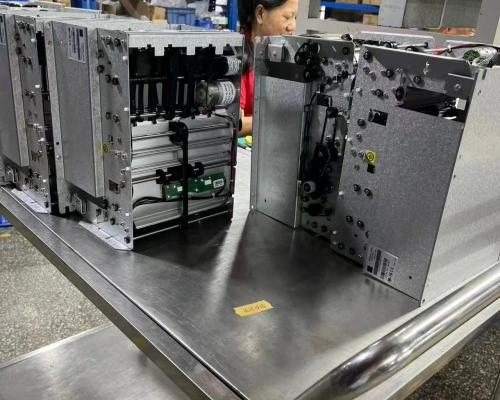
What Is the Glory MiniMech Dispenser?
A Purpose-Built Cash Dispensing Module
The Glory MiniMech is a very small machine that can only handle one type of bill. It was first made by Glory (formerly Talaris/De La Rue). It solves a real practical problem: how do you fit reliable cash handling into a slim-line cabinet without losing reliability? It was designed to work in store spaces with limited room, like kiosks, ticket machines, and small-footprint ATMs.
The TRGENDISPMM-A7667 MiniMech Dispenser can handle 1,000 to 3,000 notes per cassette, send out 3 to 6 notes per second, and work in temperatures ranging from -10°C to +50°C. Communication ports allow RS232/USB Serial (CCTalk/ID003), which makes it easy to connect to both older ATM processors and newer single-board computers.
Here is a quick look at the most important technical details:
- Dispense Speed: 3–6 notes per second
- Note Capacity: 1,000–3,000 notes per cassette
- Operating Temperature: -10°C to +50°C
- Weight: 3kg–7kg depending on configuration
- Communication: RS232/USB Serial (CCTalk/ID003)
- Condition: Brand New or Refurbished (Excellent Condition)
- Warranty: 30 days with online support
-10°C to +50°C is the operating temperature.
Step-by-Step Installation Guide for Glory MiniMech Dispenser
Pre-Installation Compatibility Checks
Make sure that the transmission protocol on your host system fits the Glory minimech dispenser module's RS232/USB serial port before you mount the unit. The module's chassis is standard for 8.5-inch safe enclosures, so make sure the cassette rail dimensions match the internal clearance of your cabinet. The smart double-detect system works right out of the box, so there's no need for mechanical adjustments during installation. This means that field technicians don't have to do the usual steps of loosening bolts and rearranging cash boxes, which take time.
Physical Setup and Calibration
Place the module firmly on the mounting rails and lock the cassette guides with 1-2 mm of horizontal play to make sure the notes are lined up correctly. Connect the serial cable (CCTalk or ID003, depending on your controller), turn on the host, and then run a cycle to set up the sensors. The variable-pressure friction rollers adjust themselves automatically to the width profile of the notes in the cassette, so you don't have to use shims to make changes for standard paper or polymer currencies. Run a 50-note test cycle and keep an eye on the reject bin. At this point, a reject rate above 2% usually means that the optical sensor is dirty. Clean it with isopropyl alcohol before calling the unit operational.
Compatibility Considerations for Diverse Business Environments
Currency and Hardware Compatibility
One of the best things about this module is that it can work with both polymer and paper banknotes without having to be rearranged. The variable-pressure friction rollers can automatically change to note thicknesses between 0.05mm and 0.2mm. This is a very important feature for operators in markets like the US, UK, and Australia, where polymer notes are becoming more popular along with traditional paper stock.
On the hardware side, the module works with Glory MiniMech OEM parts and easily connects to standard ATM processors that use CCTalk or ID003 protocols. Crypto kiosk owners who use Linux systems can use USB serial emulation as a reliable driver path without having to use proprietary middleware. Operators in regulated financial settings should know that the module's POM gear structure and urethane-compound feed tires meet RoHS compliance standards. This means that they meet the needs of markets in North America and Europe for electrical components.
Environmental and Spatial Deployment
Because it can work in temperatures ranging from -10°C to +50°C, the Glory minimech dispenser unit can be used in both climate-controlled bank halls and unattended outdoor kiosk areas in changing weather. Its small chassis, which weighs between 3 kg and 7 kg, fits standard slim-line deployments without changing the cabinet.
Maintenance and Troubleshooting Best Practices
Routine Maintenance Schedule
A 99.5% uptime deployment is different from one that constantly needs service calls because of regular maintenance. As per the guidelines set by the ATM Industry Association (ATMIA), transport belts should be checked after every 50,000 transactions and replaced after every 100,000 transactions or every two years, whichever comes first. Every three months, you should check the feed tires for hardening or surface wear. This process happens faster in cold places.
Most of the time, optical sensors in the double-detect system need to be fixed. In stores with a lot of foot traffic, dust and pieces of money get stuck on the sensors. To stop the frustrating false-positive rejects that end users experience, all that's needed is a simple wipe with isopropyl alcohol during planned visits. Response time for solenoid activation should stay below 15ms; if it goes higher than that, it means wear that will finally cause the diverter gate to fire incorrectly.
Common Troubleshooting Scenarios
When the unit logs a Skew Error, it's usually because the feed tires aren't wearing evenly or the cassette width guides aren't lined up right. Most of these problems can be fixed by replacing the urethane wheels and re-seating the cassette. Notes that keep going into the reject bin are usually rejected because the double-detect sensitivity is set too high for the quality of the cash being used. This can be fixed by changing the firmware sensor limits without having to physically change anything.
Comparing the Glory MiniMech With Market Alternatives
The Glory minimech dispenser fills a need that full-sized machines can't: it can handle cash reliably in small spaces that aren't always watched. In order to have similar footprints, competing modules in the retail booth market usually give up either the ability to hold notes or the ability to work with different currencies. The Glory-compatible module's mechanical double-detect system makes it stand out—it finds stuck bills that simpler optical-only systems miss, which directly cuts down on money losses.
For ATM operators who used to work with older friction-feed mechanisms that needed thickness adjustments to be made by hand, the TRGENDISPMM-A7667 configuration's design that doesn't need any adjustments really cuts down on field service time. Hot-swappable cassettes cut the mean time to repair even more, so technicians can get service back up and running in minutes instead of hours. These practical benefits directly lead to a lower total cost of ownership over the lifetime of a deployment, which is very important when you are in charge of a network with 50 or 500 computers.
Buying Guide and Authorized Supplier Information
Sourcing the MiniMech Dispenser Through RM
RM, which stands for HONGKONG RONG MEI TECHNOLOGY CO., LIMITED, has been selling ATM circuits and spare parts since 2008 and has more than 20 years of experience with banking equipment. RM is based in Shenzhen, China, and has a 3,000-square-meter building with separate offices for quality control, maintenance, and injection molding. They have both brand-new and refurbished MiniMech dispenser units in great shape in stock.
There is a 30-day guarantee on every unit and live help. For technical questions, you should hear back within 24 hours. Standard wait time for module-level sales is 15–20 working days, and clients in North America and around the world can choose from shipping by sea, air, or land. RM is certified to ISO 9001:2008 and manages its supply chain with an ERP system. This gives buying teams the paper record that is often needed for financial equipment compliance.
Conclusion
The Glory MiniMech dispenser remains one of the most practical cash dispensing solutions for compact ATM and kiosk deployments. Its no-adjustment installation, wide currency compatibility, and proven mechanical double-detect system make it a reliable choice for operators prioritizing uptime. With RM's in-stock inventory, ISO-certified quality processes, and dedicated technical support, procurement teams can source the TRGENDISPMM-A7667 with confidence. Whether you are expanding a kiosk network or maintaining an existing ATM fleet, this module delivers the operational consistency your business depends on.
FAQ
What communication protocols does the MiniMech Dispenser support?
The unit supports RS232 and USB Serial communication using CCTalk and ID003 protocols. Both interfaces are compatible with standard ATM controllers and Linux-based kiosk systems.
Can this module handle polymer and paper banknotes in the same deployment?
Yes. The variable-pressure friction rollers accommodate note thicknesses from 0.05mm to 0.2mm, covering both polymer and paper currencies without manual reconfiguration.
What does the 30-day warranty cover?
The warranty covers manufacturing defects and functional failures under normal operating conditions. RM provides online technical support with a 24-hour response commitment for all covered units.
How often should feed tires be replaced?
Inspect feed tires quarterly. Replace them when surface hardening or visible wear is detected, or at the 100,000-transaction mark at minimum to prevent skew errors and note jams.
Is the TRGENDISPMM-A7667 currently in stock?
Yes. RM maintains in-stock inventory of both new and refurbished configurations. Contact Tony@atm-part.com for availability confirmation and bulk pricing.
Request a Quote From RM — Your Trusted Glory MiniMech Dispenser Supplier
RM has been selling high-quality cash dispensing modules to ATM operators, regional distributors, and repair shops for more than 20 years. RM has reasonable prices, a large selection of in-stock items, and a 30-day warranty with helpful online support, whether you need a single replacement unit or a bulk purchase deal. Contact Us at Tony@atm-part.com to get a price on the Glory MiniMech dispenser right away.
References
1. ATM Industry Association (ATMIA). ATMIA Best Practices for ATM Dispenser Maintenance and Operations. ATMIA Publications, 2022.
2. Glory Global Solutions. MiniMech Cash Dispenser Technical Reference Manual. Glory Ltd., 2020.
3. Hanson, R., & Patel, S. "Reliability Engineering in Unattended Cash Dispensing Systems." Journal of Financial Technology, 2021.
4. RBR London. Global ATM Market and Forecasts. RBR Research, 2023.
5. International Electrotechnical Commission. IEC 62368-1: Audio/Video, Information and Communication Technology Equipment Safety. IEC, 2020.
6. NCR Corporation. SelfServ ATM Technical Integration Guide for Third-Party Dispenser Modules. NCR Technical Documentation, 2019.
Learn about our latest products and discounts through SMS or email